Local SEO Research | Q2 2026
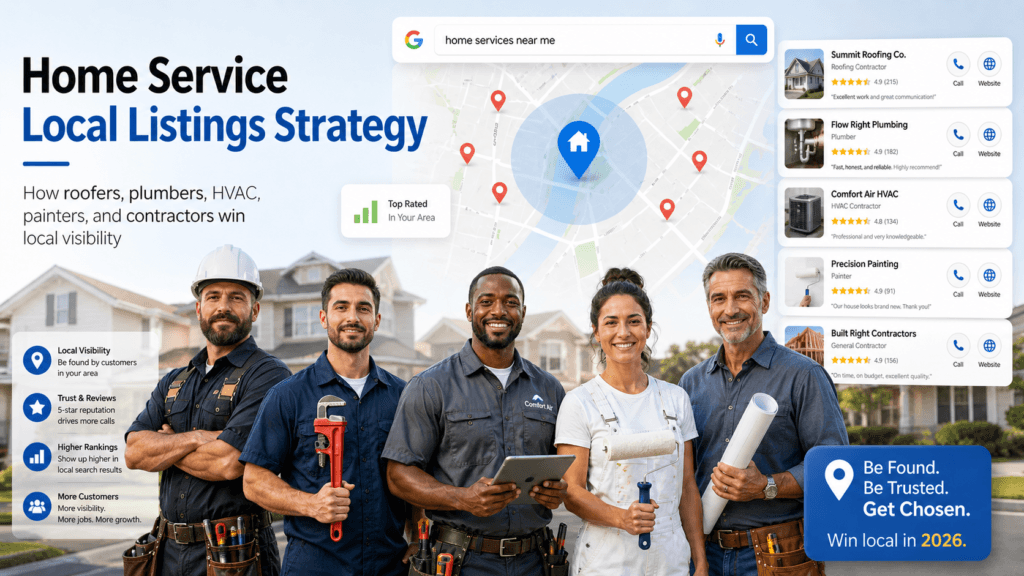
97% of consumers read online reviews before choosing a local business. 41% do it every single time, up 12 points from last year. 47% will not consider a business with fewer than 20 reviews. This is the competitive environment facing every roofer, plumber, HVAC contractor, painter, and general contractor in 2026.
This guide draws on the BrightLocal 2026 Local Consumer Review Survey (1,002 U.S. consumers), the Whitespark 2026 Local Search Ranking Factors (47 top local SEO experts), and Google’s published guidance on local ranking. No invented weights. No tactics that expire next quarter.
The Four-Front Framework
Google states that local ranking is primarily driven by relevance, distance, and prominence, and explicitly keeps algorithm details confidential. The right strategy is not chasing a factor weight chart. It is building the strongest real-world signal set across four fronts at once:
- A compliant, fully built Google Business Profile
- A systematic review engine
- A website that proves service-area relevance with real local proof
- Measurement tied to booked jobs and revenue, not rank screenshots
Each front reinforces the others. A strong GBP without reviews looks thin. Strong reviews without supporting website pages lose the confirmation layer. Good local pages without proper measurement mean you cannot make smart reinvestment decisions about what is actually driving booked work.
1. Get the Location Model Right First
Everything else sits on top of this. Google’s policy is clear: P.O. boxes and mailbox addresses are not allowed, virtual offices are not eligible, and co-working spaces only qualify if they have proper signage, actually receive customers during stated hours, and are staffed by the business’s own team during those hours.
This matters because the Whitespark 2026 survey consistently documents that visible-address businesses outperform hidden-address service-area businesses in Maps and local pack results. If the business has a real, staffed, customer-facing location that meets Google’s rules, use it. If not, run a compliant service-area profile and compensate with stronger reviews, deeper local pages, and paid visibility through Local Services Ads.
Fabricating a location advantage creates real profile suspension risk. That is recoverable, but it can cost weeks of local pack visibility at the worst possible time.
2. Build the Google Business Profile Like a Primary Sales Asset
GBP signals carry roughly 32% of local pack ranking influence according to the Whitespark 2026 survey, the single highest-impact lever available. Google’s documentation confirms that complete, accurate profile information makes a business more likely to appear, and specifically calls out address, phone number, business type, hours, review responses, and photos as key completeness signals.
Primary Category: Get This Right
The primary category should match the highest-value lead type the business actually wants most. Common assignments for home service trades:
- Roofing business: Roofing Contractor
- Plumbing business: Plumber
- HVAC business: HVAC Contractor
- Painting business: Painter
- General contractor: the most specific remodel or construction category that fits the actual work
Expand with relevant secondaries after setting the primary. Getting the primary wrong means fighting uphill on every important search. Getting it right is one of the highest-ROI decisions in local SEO.
Hours and After-Hours Availability
The Whitespark 2026 survey flags “business is open at time of search” as one of the most influential local factors. For urgent trades such as plumbing, HVAC, and emergency roofing, real after-hours availability is a genuine competitive edge. If the business answers the phone at 10 p.m., the profile should say so. Competitors running 8-to-5 hours lose those urgent calls entirely.
Photos and Visual Proof
Google explicitly recommends photos and videos. For home services, visuals carry unusual weight because the work itself is persuasive: trucks, crews, materials, installations, before-and-after comparisons, visible craftsmanship. A roofer or painter with real job photography consistently looks more trustworthy than a competitor relying on stock images.
The 2026 Spam Crackdown
In April 2026, Google announced it is deploying Gemini AI to detect fake profile edits faster and is sending proactive email alerts to verified owners before important changes go live. Its 2025 Trust and Safety Report documented 292 million policy-violating reviews blocked, 79 million inaccurate edits blocked, and 13 million fake Business Profiles removed. Deceptive tactics carry materially higher risk in 2026 than at any point in recent years.
GBP Health Scorecard
Check every item that currently applies to your Google Business Profile. Your score and recommended next steps update in real time.
Check the items below to see your score and get personalized next steps.
A. Profile Foundation
B. Hours and Availability
C. Photos and Media
D. Reviews
E. Website and Off-Profile Presence
3. Build a Review Engine, Not a Review Campaign
The BrightLocal 2026 Consumer Review Survey puts the stakes plainly:
The Whitespark 2026 survey puts reviews at approximately 20% of local pack ranking influence, up from 16% in 2023. Review velocity, response rate, and total count matter most. Not just the number, but the recency and specificity.
Make It Operational
Every completed job should trigger a review request by SMS or email, ideally the same day the job closes while the result is still emotionally fresh. Ask for an honest review, not a positive one. Encourage customers to describe the actual work and location. A review that mentions a specific service, a neighborhood, and the outcome does more for both ranking and conversion than a generic five-star with no text.
Respond to Every Review
Google says responses help a business stand out. BrightLocal confirms that consumers expect responses and are more likely to use businesses that reply consistently. Robotic or copy-paste responses now create their own distrust signal. Consumers identify a template within the first sentence. Write real responses, or at minimum personalize the opening line.
4. Treat the Website as the Proof Layer
The GBP gets impressions. The website is where Google and customers confirm whether the business actually deserves to rank and be hired. For home service companies, the right structure requires genuine execution:
- Service pages: One dedicated page per core service. A roofer needs separate pages for repair, replacement, storm damage, commercial, and emergency work, not a single Services page listing everything in bullets.
- City and service-area pages: A distinct page for every market the business seriously competes in, with genuinely different content on each. A plumber covering Dallas, Irving, Garland, and Frisco needs a page for each.
- Project pages: Real completed jobs with location, service type, scope, and photos. A finished roof in McKinney or a full repaint in Frisco is local relevance proof, conversion content, and review support material all in one asset.
The critical constraint: city pages cannot be thin doorway clones. They need actual local proof: neighborhoods served, real project examples, service-specific FAQs, real testimonials, real images, and clear calls to action. In competitive markets, weak city pages can actively damage trust compared to having no city page at all.
5. Use Local Services Ads as Part of the System
For plumbing, HVAC, roofing, locksmiths, electricians, painting, and other eligible categories, Local Services Ads should be part of the local strategy, not a separate paid media silo. Google's own LSA guidance says star ratings and review count affect ad ranking, and recommends selecting all legitimate job types, setting service areas broadly, targeting at least five reviews, and using real job photos.
Home-service buying decisions are short and often urgent. The business appearing in both LSAs and the organic local pack with strong reviews gets repeated exposure during the same decision window. Track not just leads but booked jobs, close rate, and revenue by service and city. A lead that never converts is a budget line, not a result.
6. Apple Business and Entity Consistency
Google remains the center of gravity, but local visibility in 2026 extends beyond Google Maps. In March 2026, Apple announced Apple Business, its consolidated platform for managing how a business appears across Apple Maps, Mail, Wallet, and Siri. Apple also confirmed that local ads in Apple Maps will launch in the U.S. and Canada this summer. Any home-service business that has not claimed its Apple Business listing today is leaving a fast-growing visibility channel unclaimed.
Beyond Apple, maintaining consistent NAP (name, address, phone) across the directories customers use for reassurance is still meaningful. The Whitespark 2026 survey argues citations matter more than many in the industry assumed, particularly as AI search tools use structured data and consistent off-site mentions to decide which local businesses to recommend.
7. Measure the Whole System by Revenue
Google notes that profile engagement metrics (web traffic, calls, direction requests) factor into what the system observes about a business. The right dashboard connects every layer to actual business outcomes:
- Profile views, calls, website clicks, and direction requests
- LSA leads and lead quality by job type
- Call tracking data and form submissions
- Booked jobs, close rate, and revenue by service and geography
Rank tracking still has value as a visibility diagnostic, especially geo-grid tools that show how rankings shift across a service area. But rank is an input to business performance, not the output. A properly connected GA4, GTM, and call-tracking setup turns local SEO from a marketing activity into a decision system: which services, which cities, and which campaigns generate qualified demand that turns into booked work.
90-Day Rollout Plan
Fix the Foundation
- Confirm location model compliance
- Set correct primary and secondary categories
- Fill out services, description, and hours
- Upload 20+ real job photos
- Verify phone routing and contact links
- Launch post-job review request
- Align LSA setup if eligible
Build the Proof Layer
- Write or rewrite core service pages
- Build priority city landing pages
- Add real local proof to each page
- Publish project pages from recent jobs
- Standardize post-job asset collection
Expand and Measure
- Claim and optimize Apple Business
- Audit NAP across all directories
- Refine LSA job types and coverage
- Move KPIs to booked-job revenue
- Set up geo-grid rank tracking
What to Deprioritize or Avoid
- Made-up factor weightings: Google says algorithm details are confidential. Industry survey data is directional context, not a calculation recipe.
- Fake locations or virtual offices: Policy violation and real suspension risk. Not worth it under any market pressure.
- Thin city pages and stock photos: They weaken trust exactly where home-service buyers are looking hardest for reassurance.
- Generic review responses: Consumers identify templates immediately. Personalize the opening line at minimum.
- Ignoring Apple Business: With Apple Maps ads launching this summer in the U.S. and Canada, Apple is no longer a secondary afterthought for local discovery strategy.
- Measuring success by rank screenshots alone: The goal is booked work and revenue. Rank is a leading indicator, not a business result.
Bottom Line
The best Q2 2026 local listings strategy for a home service business is to build the strongest possible real, compliant, review-rich, proof-heavy local entity. A correctly positioned Google Business Profile. An honest location model. A disciplined review engine. Strong service and city pages. Steady project proof. LSA support where eligible. Entity consistency across Google and Apple Business. And measurement tied to booked jobs, not vanity metrics.
The businesses that win are not doing the most SEO tricks. They are making it easiest for Google and customers to conclude, at every touchpoint, that they are the best real option nearby.
Work With Omega Function
Ready to build this for your home service business?
Send us a message or Loom walkthrough of your current setup and we will walk through exactly where your biggest gaps are and how to close them.
Want this kind of insight applied to your stack?
Send a Message or Loom walking through your current setup and we'll come back with a scoped plan, not a sales pitch.
Get Started →