For lead gen websites, the most disorienting thing about 2026 is not that traffic dropped. It is that the traffic drop does not mean what it used to mean.
AI Overviews, AI Mode, and AI-heavy local search experiences are now answering upper-funnel and mid-funnel questions before a user ever reaches your website. Google’s own documentation describes AI Overviews as designed to help people “get to the gist of a complicated topic or question more quickly, and provide a jumping off point to explore links to learn more.” That sounds helpful. For businesses that used to monetize those informational clicks, it is a major structural shift.
Here is the scale of that shift right now:
of Google searches triggered AI Overviews in late 2025, up from 6.5% in January
of AI Overview-triggering queries were informational intent vs. just 1.76% transactional
of consumers used AI tools for local business recommendations in the last year, up from 6% the prior year
That 45% figure is worth sitting with. In one year, AI went from a niche tool for local recommendations to the first stop for nearly half of all consumers. That is not a traffic blip. It is a structural shift in where early-funnel education happens.
The Two-Surface Problem
Search Engine Land’s 2026 content strategy reporting identified what they describe as a decoupling of traffic and visibility: a page can lose Google clicks while gaining citations or influence in AI-driven results. A piece that never ranked organically might be cited regularly by an AI system. The inverse is also true.
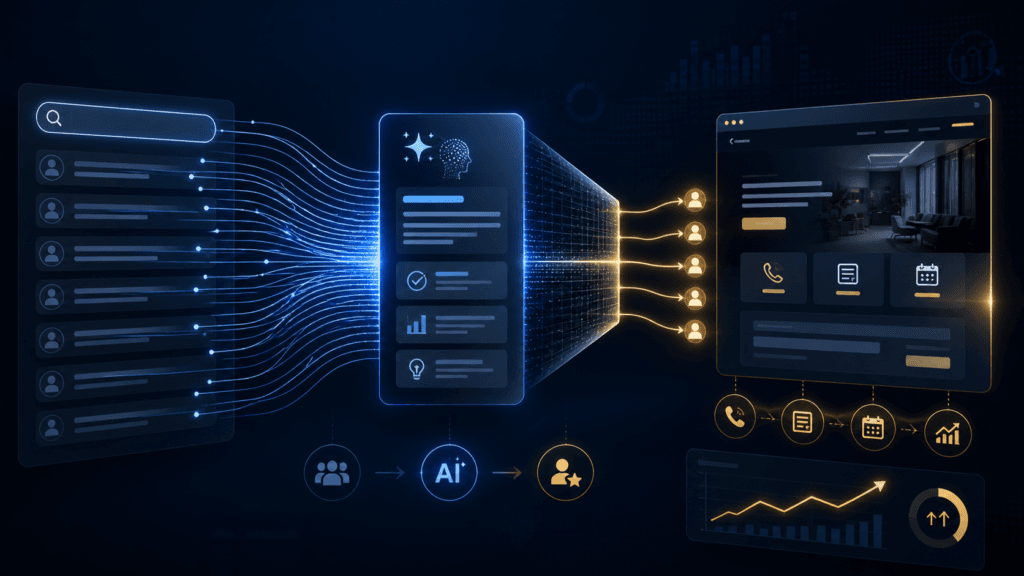
The new model: Google and AI handle part of the education. Your website has to close.
That is a fundamentally different job. Websites that relied heavily on informational clicks are absorbing most of the pain right now. Brands that make the next step obvious, credible, and frictionless still have room to win.
The Compressed Funnel: What the Data Shows
There is an upside buried inside the traffic drop. When a user arrives after an AI Overview has already answered the “what is this” and “how does this work” questions, they are often closer to a decision. The funnel is compressed, not eliminated.
BrightLocal’s 2026 Local Consumer Review Survey captures this dynamic clearly in the context of review behavior:
of consumers are ready to buy or book immediately after reading positive reviews
visit the business website after reading positive reviews, up from 32% in 2019
The site visit is increasingly happening later and closer to the point of action. Website visits after reading reviews are 69% higher than they were in 2019. The website is not losing relevance. It is shifting its role from “first touchpoint” to “confirmation and conversion layer.”
Check Your Site: Lead Gen AI Readiness Scorecard
These six questions identify whether your lead gen site is built for the old informational model or the new conversion-first environment. Answer honestly.
Lead Gen AI Readiness Check
6 questions. About 60 seconds. See where your site stands.
1. Do your service or location pages include specific details like pricing ranges, turnaround times, or service area boundaries?
2. Does your site include an interactive tool that helps visitors decide (estimate calculator, service-fit quiz, coverage checker, or booking widget)?
3. Do you track qualified leads, booked consultations, and close rate separately from raw traffic and impressions?
4. Is your Google Business Profile fully built out with services, attributes, photos updated in the last 60 days, and an active review response practice?
5. Do you have structured data (schema markup) implemented on your service pages and location pages?
6. Do you actively generate and manage reviews across at least two platforms where your ideal clients look?
At Risk
Your site is built for the old model.
Five Shifts That Separate Brands Still Winning in 2026
Stop Using Traffic as Your Primary Success Metric
The useful scorecard now: qualified calls, qualified forms, booked consults, close rate, and visibility across both classic organic and AI-mediated search. Traffic is a lagging and increasingly incomplete indicator of actual business health.
Build Money Pages as Truth Anchors
AI-driven local discovery increasingly favors explicit, first-party facts for objective queries: hours, service availability, locations, turnaround times, and specific offerings. Service pages need to be brutally specific about what you do, where, how fast, and what the next step looks like.
Offer Something AI Cannot Finish
Static information is increasingly easy to summarize. Decision-support tools are not. Instant estimate tools, service-fit quizzes, coverage checkers, timeline calculators, and live booking selectors give visitors a reason to stay and a clear path to act.
Optimize for Conversion on the SERP, Not Just on the Site
Local search is now about being chosen, not just clicked. Treat Google Business Profile as a true product surface: keep services, offers, photos, and review responses current. Measure on-SERP conversions alongside site conversions. LocalBusiness structured data helps Google surface your core details directly in results.
Strengthen Reputation Signals Everywhere AI Looks
For subjective queries like "best" or "most trusted," AI systems lean on reviews, third-party commentary, and editorial consensus. BrightLocal's 2026 data shows consumers fact-check AI-cited reviews and continue researching through websites, additional reviews, and social. Your website is one proof layer among several.
What to Measure Now
If you are reporting to a client or a leadership team, this is the measurement shift that matters most: traditional organic performance and AI visibility no longer move in lockstep. They need to be tracked separately.
| Old Metric | Why It Breaks | Replace or Add |
|---|---|---|
| Organic sessions | AI Overviews reduce clicks even when rankings hold | Qualified leads + booked consults + close rate |
| Keyword rankings | A page can rank and still lose traffic to AI summaries | AI citation tracking + GBP call and direction volume |
| Impressions | Impressions inflate as AI Overviews expand reach without generating click intent | CTR by query type + on-SERP action rate |
| Page views per session | Compressed funnels mean fewer pages visited before converting | Conversion rate on first-session visits + form and call quality scores |
The Working Thesis for 2026
AI Overviews are not simply stealing clicks. They are redistributing where education happens. A user who arrives on your site after an AI Overview has often already processed the explainer layer. They are not looking for the same page they used to find through an informational search. They want confirmation, specificity, and a clear next step.
The lead gen sites that restructure around that reality will be positioned to win. The ones that keep chasing the informational-click model will keep absorbing the pain.
If your lead gen site needs a conversion-focused SEO strategy built for 2026, that is exactly what we build. Send us a message or Loom with a quick look at your current setup and we will show you where the gaps are.
Want this kind of insight applied to your stack?
Send a Message or Loom walking through your current setup and we'll come back with a scoped plan, not a sales pitch.
Get Started →