At a Glance
Does SEO still matter for AI search?
Yes. Google’s AI features run on the same core indexing and ranking systems as traditional Search.
What does Shepard’s research add?
23 scored factors correlated with AI citations across ChatGPT, Gemini, and Perplexity.
Does adding schema boost AI citations?
Not on already-cited pages, per Ahrefs’ controlled study of 1,885 URLs.
Is Google’s guide the complete playbook?
No. Serious GEO strategy requires combining it with independent research and ongoing measurement.
Google recently published official guidance on optimizing websites for generative AI features in Search, including AI Overviews and AI Mode. The guide is useful, particularly because it confirms something many technical SEOs have suspected: generative AI visibility in Google Search is still closely tied to traditional Search systems, including crawling, indexing, ranking, content quality, and technical accessibility.
“Our generative AI features on Google Search are rooted in our core Search ranking and quality systems.”
Google, AI Optimization Guide
That matters because it means SEO is not dead. It means SEO has expanded.
But it also means the conversation around AI visibility, AEO, and GEO needs to go deeper than reading one official guide and assuming we have the whole picture.
Google’s AI optimization guide is a good foundation. It is not the full map.
What Google’s Guide Actually Confirms About SEO
One of the clearest takeaways from Google’s guide is that foundational SEO still drives generative AI visibility. Google says pages need to be eligible for Search, indexed, snippet-eligible, crawlable, technically accessible, and structured clearly enough to process.
The guide also emphasizes:
- ✓Non-commodity content that reflects unique perspectives and first-hand experience
- ✓Clear organization with meaningful headings and paragraphs
- ✓High-quality images and video where relevant
- ✓Reduced duplicate content and good page experience across devices
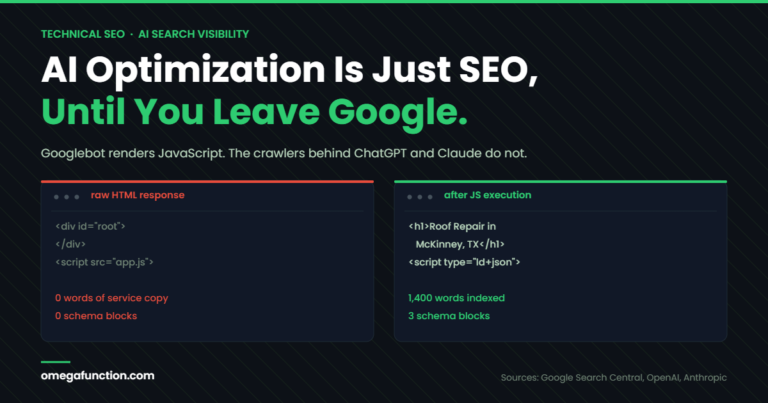
- ✓JavaScript SEO best practices for framework-heavy sites
- ✓Local and ecommerce data hygiene through Google Business Profile and Merchant Center
This pushes back against the idea that AI search optimization is a separate discipline from traditional SEO. For Google Search specifically, GEO is not a replacement for SEO. It is a new layer on top of it.
If a page cannot be crawled, indexed, rendered, understood, ranked, or trusted, it is unlikely to become a strong source for AI-generated answers. Technical SEO is now part of AI visibility infrastructure.
38%
of Google AI Overviews citations come from the top 10 organic search results
23
AI citation-correlated factors identified across ChatGPT, Gemini, and Perplexity
Official Guidance Is a Baseline, Not the Full Recipe
Google’s documentation is valuable, but Google has never published the exact formula behind rankings. Its own ranking systems documentation describes Search as using automated systems that evaluate many factors and signals across hundreds of billions of pages. Page-level systems, site-wide signals, classifiers, and ongoing testing all contribute to how content is ranked and surfaced.
Official guidance should be treated as a baseline, not the end of the investigation.
Google can tell us what to prioritize. It can tell us what not to obsess over. It can clarify what is required versus what is not. But it does not publish exact weights, thresholds, interaction effects, or the full mechanics of how a page becomes the chosen citation in an AI-generated result.
That is where independent testing, third-party research, and careful interpretation add genuine value.
Cyrus Shepard’s AI Citation Research Adds the Tactical Layer
Cyrus Shepard’s AI citation ranking factors analysis, published on Signal by Zyppy, synthesizes evidence from 54 published experiments, studies, explainers, and patents across AI systems including ChatGPT, Gemini, and Perplexity. Shepard is explicit that these factors represent characteristics correlated with AI citations, not causal ranking factors. That distinction matters because correlation is not causation.
The analysis scores 23 factors across three criteria: repeatability, strength of evidence, and support from official documentation or patents. The top ten:
9.5
9.4
9.3
9.2
9.2
9.0
8.9
8.8
8.6
8.3
One supporting statistic: approximately 38% of Google AI Overviews citations originate from the top 10 organic search results. That single figure illustrates how tightly AI citation and traditional search rank are linked.
Many of the strongest citation-associated factors look like advanced SEO fundamentals. The research suggests that the way information is structured, placed, phrased, and supported may influence whether AI systems can extract and cite it. This is the practical middle ground: we do not need to write awkward pages for robots, but we also should not ignore the mechanics of retrieval, passage selection, and citation behavior.
What “Don’t Focus on Chunking” Actually Means
Google’s guide says there is no requirement to break content into small pieces for AI to understand it. There is no ideal page length, and content should be made for the audience rather than for generative AI systems specifically. That is sensible advice.
But it should not be misread as meaning content structure does not matter. Google operates a passage ranking system designed to identify individual sections within a page and evaluate relevance. Shepard’s analysis also identifies answer placement, AI-ready structure, factual specificity, and self-contained passages as citation-correlated traits.
The Right Interpretation
Structure pages so humans can understand them and machines can extract the important parts without confusion.
That means clear headings, direct answers near the top, specific claims backed by evidence, visible HTML text, tables where they add clarity, and passages that hold meaning when pulled from the surrounding page.
What the Ahrefs Schema Study Actually Shows
Ahrefs published a controlled study on schema markup and AI citations. The study tracked 1,885 pages that added JSON-LD schema between August 2025 and March 2026, matched against 4,000 control pages, and measured citation changes across Google AI Overviews, Google AI Mode, and ChatGPT over a 30-day window. The methodology included a matched difference-in-differences analysis, an event study design, and two additional statistical tests.
Results by platform:
That is a useful caution against overselling schema as an AI citation shortcut. But the study’s scope is narrower than some interpretations suggest. Every page in the dataset already had 100 or more AI Overview citations before schema was added. Ahrefs explicitly states the study cannot directly answer whether schema might help pages that are not yet visible to AI systems get indexed in the first place.
A separate experiment cited within the Ahrefs article, conducted by searchVIU, found that major AI systems including ChatGPT, Claude, Perplexity, Gemini, and Google AI Mode appear to ignore JSON-LD during direct retrieval, extracting only visible HTML.
Wrong conclusion
Schema does not matter for AI search.
Better conclusion
Adding JSON-LD to pages already receiving substantial AI citations does not appear to produce a meaningful short-term citation increase.
That is still a valuable finding. It just does not end the schema conversation.
Structured Data Is Infrastructure, Not a Citation Shortcut
Google says structured data is not required for generative AI search and that no special schema.org markup is needed for AI features. But Google also says structured data remains worth using as part of a broader SEO strategy because it supports rich result eligibility.
✗
Will schema automatically generate AI citations?
No.
✓
Can it still support broader search visibility?
Yes.
For local businesses, ecommerce sites, service businesses, and brands without established entity signals, structured data is part of the trust and clarity layer that supports long-term visibility. It is not the whole strategy, but one controlled study with a narrow scope is not a strong basis for abandoning it either.
Google Is Not the Only AI Search Environment
Another reason to avoid oversimplified conclusions: Google is not the only player in AI search. ChatGPT, Gemini, Perplexity, Claude, Bing Copilot, and emerging agentic systems may retrieve, summarize, rank, cite, and validate sources in different ways. The Ahrefs study measured different outcomes across three platforms from the same schema intervention, with meaningfully different results on each.
That means a tactic Google says not to overfocus on may still matter differently elsewhere. Clear passage structure, self-contained answers, top-of-page placement, visible content, and extractable facts may carry different weight across platforms. Shepard’s analysis specifically identifies self-contained passages, visible content, freshness, brand and entity trust, and entity consistency as citation-correlated factors across the AI systems studied.
The smarter strategy is not chasing every new AI rumor. It is building content and technical systems that work across search, AI retrieval, citation, summarization, and human conversion.
A More Complete GEO Strategy
A serious AI visibility strategy includes what Google recommends, but does not stop there. Use the scorecard below to see where your site currently stands across the four pillars that drive AI search performance.
GEO Readiness Check
How AI-Ready Is Your Site?
Check every item your site has in place. Your score updates in real time.
Technical Foundation
Content and Retrieval
Authority and Trust
Measurement
The Takeaway
Google's AI optimization guide confirms that SEO still matters, that technical accessibility still matters, and that non-commodity content is increasingly important in generative AI search. No single guide, even from Google, should be treated as the complete playbook.
Google gives us the foundation. Shepard's research identifies citation-correlated patterns with tactical detail that official documentation does not provide. The Ahrefs schema study helps separate hype from measurable impact.
AI visibility is not about one tactic. It is not just schema. It is not just content. It is not just rankings. It is the combination of technical visibility, crawlability, retrieval readiness, content quality, entity clarity, trust signals, answer structure, and ongoing measurement.
The sites that win in AI search will not be the ones chasing every new acronym. They will be the ones that are easy for humans to trust, easy for search engines to understand, and easy for AI systems to retrieve, summarize, and cite. AI search does not lower the bar for SEO fundamentals. It raises the bar for how precisely they need to be executed.
Get a GEO Audit
Want to Know Where Your Site Actually Stands?
We will walk through your technical foundation, content structure, entity signals, and measurement setup and tell you where the gaps are and what to fix first.
Sources
Want this kind of insight applied to your stack?
Send a Message or Loom walking through your current setup and we'll come back with a scoped plan, not a sales pitch.
Get Started →