At a Glance
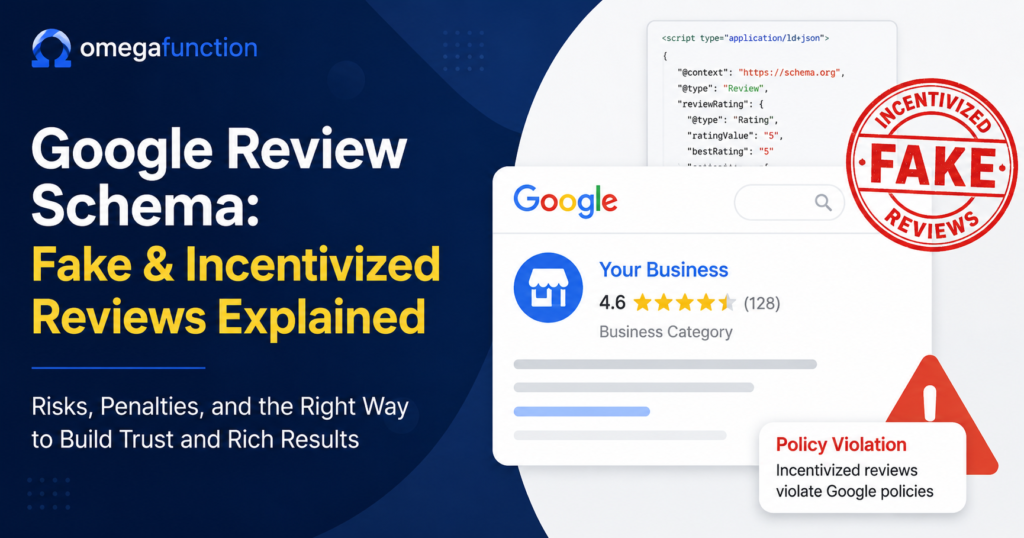
On July 24, 2026, Google added a new line to its review snippet structured data documentation: do not include fake or undisclosed incentivized reviews on your page or in your markup. The change is short, but it moves review integrity from a reputation question into a technical compliance question with a manual action attached. If your site displays reviews, marks them up, or averages them into an aggregate rating, the text on the page and the data in the markup now both have to hold up.
| What changed | Google’s review snippet guidelines now explicitly prohibit fake reviews and incentivized reviews that are not clearly and prominently disclosed, in visible page content and in structured data |
| Who it hits hardest | Local and service businesses, med spas, law firms, home services, and ecommerce sites that collect reviews through a request flow or an incentive program |
| The older rule most sites still break | Since 2019, reviews a business controls about itself have been ineligible for the star review feature under LocalBusiness or Organization markup, including reviews pulled in through an embedded third-party widget |
| The penalty | Google may take manual action against a site that violates the review snippet guidelines, which means losing review rich results until the issue is fixed and a reconsideration request is accepted |
| What to do next | Run the eligibility check and the trust signal audit below, then work the 30-day cleanup: inventory, remediate, harden |
Review schema has always been treated as a formatting exercise. Get the properties right, pass the Rich Results Test, collect the stars. The July 2026 update reframes it. Google is now asserting a claim about the reviews themselves, not just the way they are encoded, and it is doing so in the same document that governs whether your rich result appears at all.
The practical version: review markup is not a place to launder trust. Your reviews, your testimonials, your structured data, and the copy a visitor actually reads all have to describe the same reality.
What Google actually added
The review snippet structured data documentation gained a new guideline on July 24, 2026. The wording is direct:
Don’t include fake or undisclosed incentivized reviews on your page or in your structured data markup.
Google gives two examples of what falls inside that prohibition. The first is reviews that are not based on a genuine experience of a product or service. The second is reviews written in exchange for a benefit, such as money, discounts, vouchers, or free products, that do not clearly and prominently disclose the incentivization. Google’s changelog states the reason for the change in six words: to improve user review transparency.
Two details matter more than the headline. First, the guideline covers the page and the markup. This is not a structured data validation rule. A review that fails the test is a problem even if you never wrapped it in JSON-LD. Second, this guideline sits inside the section of the documentation that carries Google’s manual action language: if a site violates one or more of these guidelines, Google may take manual action against it, and the site can request reconsideration after fixing the problem. Search Engine Journal and Search Engine Land both covered the change when it landed.
Notice what Google did not say. It did not ban incentivized reviews. Offering a gift card for a review is still allowed under this guideline, as long as the incentive is disclosed clearly and prominently, and as long as the review reflects a real experience. The prohibited thing is the concealment, not the incentive.
Why this lands harder in 2026 than it would have in 2019
Reviews stopped being decoration a while ago. They are now conversion proof, local ranking input, and increasingly, the raw material that AI systems summarize on your behalf. BrightLocal’s most recent Local Consumer Review Survey puts numbers on how far that has gone.
97%
of consumers read reviews for local businesses, and 41 percent now say they always read them, up from 29 percent a year earlier
82%
read AI-generated review summaries, and 23 percent rely on those summaries alone to make a decision, which means a machine is reading your review corpus before a human does
31%
will only consider a business rated 4.5 stars or higher, up from 17 percent the year before, so a half-star of inflated average is worth real money and real risk
The same survey found that 97 percent of consumers believe businesses should face some consequence for fake reviews, and 46 percent think offenders should be removed from Google search results entirely. Google enforcing a transparency rule here is not Google being unusually strict. It is Google catching up to what its users already expect.
The AI summary number is the one worth sitting with. When 82 percent of people are reading a generated summary of your reviews, the thing being summarized is your whole review corpus, including the four-star review that mentions a scheduling problem. Padding that corpus with reviews that were bought, staged, or written internally does not just risk a manual action. It teaches the summarizer something about your business that is not true, which is a fragile place to build a pipeline on.
The eligibility rule most sites already break
Before the new guideline, there was an older one that catches more sites than anything Google published this month. In September 2019, Google stopped showing self-serving review stars for LocalBusiness and Organization schema. The current documentation still carries it: if the entity being reviewed controls the reviews about itself, pages using LocalBusiness or any other Organization type are ineligible for the star review feature.
Self-serving means a review about entity A placed on entity A’s own website. Adding it directly to your markup counts. So does pulling it in through an embedded third-party review widget. The widget being third-party does not change who the review is about or whose site it is on.
This is why so many businesses have valid, error-free review markup that has never produced a single star in a search result. The markup is not broken. The page is not eligible. Those are different problems with different fixes, and it is worth knowing which one you have before you start editing JSON-LD.
Review Snippet Eligibility
Are your reviews eligible for star results?
Three questions. Answer for the page that carries your review markup.
Your result appears here as you choose.
1. What is the review actually about?
2. Whose website is the review displayed on?
3. Were any of these reviews incentivized?
What clear and prominent disclosure looks like
Google did not publish a disclosure template, which means the standard is going to be read the way regulators read it: would a reasonable person see it, and would they understand it, at the moment they are forming an opinion. A line in your terms page does not meet that bar. Neither does a footnote below the fold.
Will not hold up
- A general note in the site footer or terms page saying reviews may be incentivized
- An aggregateRating of 4.9 in the markup while the page shows twelve reviews averaging 4.2
- A verified buyer badge on a review written by a staff member or a contractor
- Disclosure that lives only in the structured data and never appears in the visible content
- A review request that offers the gift card only if the customer leaves five stars
Will hold up
- A short line directly beneath the reviewer name: this reviewer received a free product in exchange for an honest review
- The same disclosure text carried into the review body in your markup, so page and data agree
- An incentive offered for any review regardless of rating, and stated that way in the request
- Employee and contractor reviews labeled with the relationship, or excluded entirely
- An aggregate that is calculated from the reviews actually rendered on the page
The aggregate mismatch is the one we find most often, and it is rarely deliberate. A plugin caches an average, someone prunes old reviews, and the number in the markup drifts away from the number on the page. Under the old reading that was a data hygiene issue. Under the new reading it is a page making a review claim it cannot support, which is closer to the thing Google just prohibited.
This is not only a Google problem
Google's guideline arrived roughly two years after the Federal Trade Commission's Trade Regulation Rule on the Use of Consumer Reviews and Testimonials, which took effect on October 21, 2024. The two overlap heavily, and the FTC version has sharper teeth.
The rule prohibits creating, buying, or selling fake consumer reviews and testimonials, including ones generated by AI. It prohibits paying for either positive or negative reviews. It requires insiders, meaning officers, managers, employees, and their immediate relatives, to clearly disclose their relationship when writing a review. It prohibits company-controlled review sites that present themselves as independent, certain review suppression practices, and buying fake indicators of social media influence. For knowing violations the FTC can seek civil penalties, set at 51,744 dollars per violation when the rule took effect and adjusted annually for inflation.
So the compliance picture is layered. Google can take your stars. The FTC can take considerably more. If you have been treating incentivized review disclosure as an SEO nicety, the honest framing is that it has been a legal requirement in the United States since late 2024, and Google has now made it a search requirement too. One cleanup covers both.
Audit your review trust signals
The checklist below is the one we work through on client sites. Check what is actually true today, not what the policy document says should be true.
Review Trust Signal Audit
How clean are your review signals?
Check every statement that is true for your site right now.
Authenticity
Incentives and disclosure
Markup and eligibility
Governance
A 30-day cleanup
Most of the work here is inventory, not engineering. The order matters, because remediating before you have a complete list produces a page that looks clean and an underlying dataset that is still wrong.
Days 1-10
Inventory
- Export every review rendered on the site and every review inside your structured data, and compare the two lists
- Flag anything that came from an incentive program, a staff member, a contractor, or a vendor
- Run the Rich Results Test on each template that carries review markup
- Check the Manual actions report in Search Console and record the result with a date
Days 11-20
Remediate
- Remove reviews that are not tied to a genuine experience, from the page and from the markup
- Add a clear disclosure beside every incentivized review you keep
- Recalculate aggregateRating from the reviews the page actually displays
- Drop self-serving LocalBusiness and Organization review markup that was never eligible for stars
Days 21-30
Harden
- Rewrite the review request so the incentive is not tied to a rating and goes to every customer, not just the happy ones
- Build the disclosure string into the submission flow so it attaches automatically
- Write down who owns reviews and when the policy gets reviewed
- Schedule a quarterly re-check of markup, aggregate values, and manual actions
What we check first
When a review integrity question comes to us, we do not open the JSON-LD first. We open the page and count. If the visible reviews do not reconcile with the aggregate in the markup, everything downstream of that is noise, and it is the fastest signal that the review system has been running unattended.
After that, three things in order. Whether the page was ever eligible for stars in the first place, because a surprising number of review implementations are technically flawless and structurally disqualified. Whether any review in the set came from an incentive, which usually requires talking to whoever runs the email flow rather than reading the site. And whether the review plugin is generating markup the team has never actually seen, which is common enough that we treat plugin-generated structured data as unverified until proven otherwise.
None of this is exotic work. It is the same discipline that keeps the rest of a technical SEO program honest: make the data on the page and the data in the markup describe the same thing, then keep them that way. The businesses that feel this update hardest are the ones where reviews were outsourced to a plugin and a vendor and then never looked at again. For regulated and high-trust verticals, where a review is often the last thing a person reads before making an expensive decision, that gap is worth closing regardless of what Google publishes next. We see it most often on med spa and law firm sites, where the incentive program and the website are usually managed by two different people who have never compared notes.
If you want a second set of eyes on how your review markup, disclosure, and page content line up, send a message or a Loom and we will take a look.
Frequently Asked Questions
No. The guideline prohibits fake reviews and incentivized reviews that are not clearly and prominently disclosed. An incentivized review that reflects a genuine experience and carries a visible disclosure is still permitted under Google's review snippet guidelines. The prohibited element is the concealment, not the incentive. Separately, the FTC rule places its own limits on how incentives can be offered, including a prohibition on paying for reviews that are positive or negative by design.
Google has not published a template, so the practical standard is whether a reasonable visitor would see and understand the disclosure at the moment they are reading the review. A short line directly beneath the reviewer name meets that bar. A statement in the site footer, a terms page, or a collapsed section below the fold does not. The disclosure should appear in the visible page content, and the same text should be carried into the review body in your markup so the page and the data agree.
Not through LocalBusiness or Organization markup. Since 2019, Google has treated reviews about an entity that are hosted on that entity's own site as self-serving, and those pages are ineligible for the star review feature. Embedding a third-party review widget does not change the outcome, because the reviews are still about you and still on your site. Product review markup remains supported, and reviews on your Google Business Profile can still appear in local results because Google collects and controls those directly.
Yes. The guideline reads "on your page or in your structured data markup," which extends it past the JSON-LD to the visible content. Removing review schema from a page does not resolve a problem with the reviews themselves. If the underlying reviews are fabricated or undisclosed incentivized reviews, the page is still in violation.
The review snippet documentation states that Google may take manual action against a site that violates the guidelines. In practice that means losing review rich results, which shows up in the Manual actions report in Search Console. After correcting the issue you can submit a reconsideration request. Check that report on a schedule rather than waiting for a traffic drop, because losing stars often costs click-through rate before it costs rankings.
The review snippet structured data guidelines govern reviews on your own website and in your markup. Reviews on your Google Business Profile are governed separately by Google's Business Profile content policies, which already prohibit fake and incentivized reviews. The FTC rule applies to both. In other words, cleaning up your site does not exempt the profile, and cleaning up the profile does not exempt the site.
They overlap but they are not the same. The FTC's Trade Regulation Rule on the Use of Consumer Reviews and Testimonials took effect on October 21, 2024 and applies as law in the United States, with civil penalties available for knowing violations. Google's guideline is a condition of appearing in a search feature, enforced through manual actions. The FTC rule is broader, covering review suppression, company-controlled review sites presented as independent, insider reviews, and fake social media indicators. A single cleanup usually satisfies both.
Structured data is not a ranking factor on its own. Removing review markup that was never eligible for stars costs you nothing in rankings, and it removes a claim your page cannot support. What can change is click-through rate, but only if the markup was actually producing stars. If it was not, and for self-serving LocalBusiness markup it was not, then the only thing you lose is the risk.
Sources
- Review Snippet (Review, AggregateRating) Structured Data - Google Search Central
- Making Review Rich Results more helpful - Google Search Central Blog, September 2019
- Google says don't include fake or undisclosed incentivized reviews in review snippet structured data - Search Engine Land, July 24, 2026
- Google Expands Review Guidelines And Warns Of Manual Actions - Search Engine Journal
- Local Consumer Review Survey - BrightLocal
- Trade Regulation Rule on the Use of Consumer Reviews and Testimonials - Federal Register, August 22, 2024
- FTC Announces Final Rule Banning Fake Reviews and Testimonials - Federal Trade Commission
Search documentation and regulatory guidance both change. This article was reviewed on July 27, 2026 against the sources listed above. Confirm the current wording of Google's review snippet guidelines and the FTC rule before making a compliance decision. See our editorial review policy for how we source and update this material.
Want this kind of insight applied to your stack?
Send a Message or Loom walking through your current setup and we'll come back with a scoped plan, not a sales pitch.
Get Started →