
At a Glance
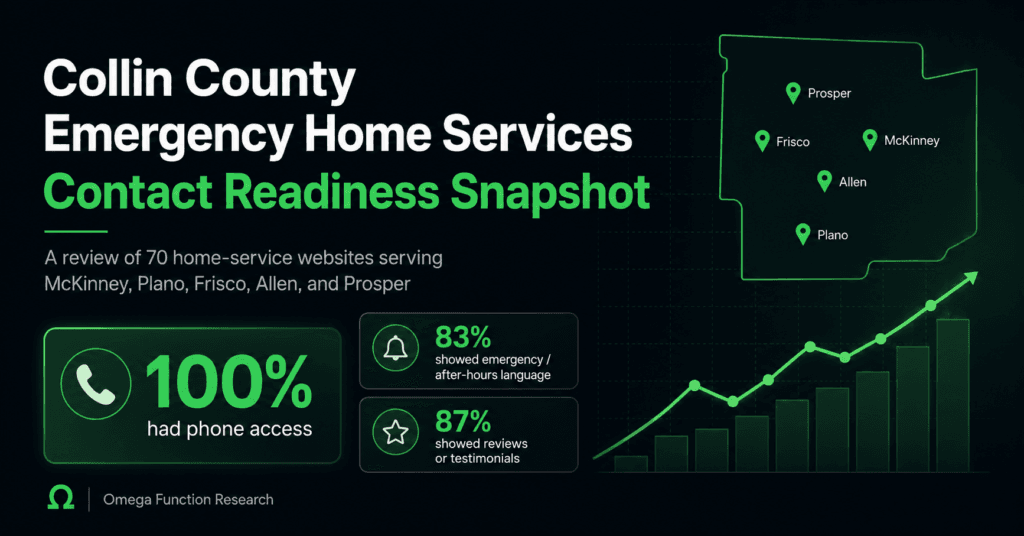
Omega Function reviewed 70 home-service websites across McKinney, Plano, Frisco, Allen, and Prosper covering roofing, plumbing, HVAC, electrical, and water restoration. Most sites handled the basics well. The clearest gaps were emergency-service language, visible testimonials, and structured data consistency.
When a pipe bursts, an AC system fails in summer, a roof starts leaking after a storm, or an electrical issue becomes urgent, homeowners are not browsing casually. They are trying to figure out who can help, whether the company serves their area, and how quickly they can make contact.
Omega Function reviewed 70 reachable home-service websites serving homeowners in McKinney, Plano, Frisco, Allen, and Prosper across roofing, plumbing, HVAC, electrical, and water restoration categories. The review focused on a single question:
If a homeowner needs urgent home-service help, how easy is it to find contact paths, emergency-service guidance, service-area information, and basic trust signals online?
This was not a ranking of individual companies. Omega Function did not publish company-specific scores. The goal was to understand, in aggregate, how clearly local home-service websites present emergency contact and confidence signals during a first-pass website review. The snapshot is intended to help homeowners understand what to look for before an emergency and help local businesses make urgent contact information easier to find.
Summary of Findings
Most reviewed Collin County-area home-service websites handled the basics well. Contact paths, service clarity, and local relevance were usually easy to find. The most common gaps were not total visibility failures. They were consistency gaps around emergency language, review visibility, and machine-readable website information.
Contact Readiness Signals across 70 Sites
Most analyzed home-service websites serving McKinney, Plano, Frisco, Allen, and Prosper made basic contact easy. Every analyzed site had a clickable or visible phone number, and nearly all had clear service descriptions, service-area signals, and contact or quote paths. The clearest opportunity areas were emergency and after-hours language, visible review proof, and structured data consistency.
Why Emergency Contact Readiness Matters
Home-service searches often happen under pressure. A homeowner may be dealing with active water damage, storm damage, a broken HVAC system, or a possible safety issue. In those moments, a website has a simple job:
- Make it clear what the company does.
- Make it clear where the company works.
- Make it easy to call or request help.
- Make urgent or after-hours options obvious.
- Give the visitor enough trust signals to take the next step.
The strongest sites in this review made those elements visible quickly. They did not force a visitor to dig through multiple pages to understand the service area, emergency availability, or contact options.
What We Reviewed
This pilot snapshot reviewed 70 clean, reachable local home-service business websites serving homeowners in five Collin County-area cities: McKinney, Plano, Frisco, Allen, and Prosper.
| Category | Sites Reviewed | Share of Set |
|---|---|---|
| Roofing | 23 | 33% |
| Plumbing | 15 | 21% |
| HVAC | 14 | 20% |
| Electrical | 12 | 17% |
| Water Restoration | 6 | 9% |
| Total | 70 | 100% |
Because many home-service companies operate across city and county lines, this snapshot should be read as a five-city Collin County-area review rather than a complete census of every provider in the county. The review focused on publicly accessible website information visible during a first-pass review.
The criteria included: clickable or visible phone access, emergency or after-hours language, service-area clarity, visible trust signals, reviews or testimonials, clear contact or quote paths, core service clarity, title and H1 clarity, structured data and schema, and no obvious indexability issues. This study did not evaluate service quality, pricing, customer experience after contact, licensing status, or actual emergency response time.
What Local Home-Service Websites Did Well
Every analyzed site had phone access
A clickable or visible phone number was found on every analyzed site. For emergency home services, this is one of the most important signals. A homeowner on mobile should not have to hunt through the footer or guess how to request urgent help.
Most sites made the core service clear
Core services were clear on every analyzed site. In most cases, a visitor could quickly tell whether the company handled roofing, plumbing, HVAC, electrical work, or restoration. Emergency visitors do not want to decode vague marketing language.
Contact paths were usually easy to find
A contact or quote path was detected on 99% of analyzed sites. This suggests that most reviewed home-service websites were built with a clear conversion path in mind, even during a quick, high-pressure visit.
Service areas were usually clear
Service-area clarity was detected on 99% of analyzed sites. That may include references to McKinney, Plano, Frisco, Allen, Prosper, Collin County, North Texas, DFW, or surrounding service areas. Clear service-area language helps connect a business to the communities it serves in both user experience and local search.
The Biggest Opportunity Areas
Three signal categories showed meaningful gaps across the 70 reviewed sites. None represent a majority failure, but each identifies a pattern worth noting for businesses in these categories.
1. Emergency and after-hours language was less consistent
Emergency intent is one of the biggest differences between home-service websites and many other local business websites. A homeowner with an active leak, failed AC system, electrical concern, or storm-damaged roof needs to know quickly whether the company handles urgent requests.
Roughly 1 in 6 analyzed sites did not clearly surface emergency, urgent, 24/7, after-hours, same-day, storm damage, water damage emergency, or similar language during the first-pass review. The opportunity is simple: if emergency service is available, make it obvious near the top of the homepage or relevant service pages.
2. Review and testimonial visibility was not universal
Trust matters when a homeowner is choosing quickly. Reviews, testimonials, ratings, or third-party review links can help a visitor feel more comfortable taking the next step.
About 1 in 7 analyzed sites did not clearly surface review or testimonial signals during the first-pass review. For local businesses, visible review proof is not just a conversion feature. It reinforces reputation and local credibility. In urgent service categories, that matters especially.
3. Structured data was present on many sites, but not all
Structured data is machine-readable information that can help search systems better understand a business, its services, its location, and other page elements. It is not something most homeowners think about directly. It is a search-readiness and AI-readiness signal.
Structured data does not guarantee rankings or inclusion in AI-generated answers. It does not replace real-world reputation or service quality. But when combined with clear public-facing content, it can help make a business easier for search systems to understand. Roughly 1 in 7 analyzed sites had no detectable structured data.
Search, Local SEO, and AI Readiness
Although this report is framed around homeowner contact readiness, many of the same signals matter for local search visibility and AI answer systems. When a website clearly states what the business does, where it works, how to contact it, whether it handles urgent requests, and what trust signals back the business, that information helps both users and search systems interpret the business more confidently.
These signals are not magic ranking switches. But they are part of a healthier local search foundation, especially for businesses that depend on urgent, high-intent local searches. Emergency contact readiness is not only a user experience issue. It is part of maintaining a clear, consistent digital footprint across traditional search, local search, and emerging AI-driven discovery surfaces.
For home-service businesses looking to strengthen their technical foundation, our schema and structured data services and monthly technical SEO address many of the signals reviewed in this study.
What Homeowners Can Check Before an Emergency
A homeowner does not need to wait until something breaks to find service providers. Before storm season, extreme heat, or winter weather, it can help to save a short list of trusted local companies. When reviewing a home-service provider online, look for:
- Is the phone number easy to find and clickable on mobile?
- Does the company clearly state the cities or areas it serves?
- Does the site explain whether emergency, same-day, or after-hours help is available?
- Are reviews, testimonials, ratings, or reputation signals easy to find?
- Are core services clear without digging through multiple pages?
- Is there a backup contact path such as a form or request-service button?
- Does the site feel current, maintained, and active?
For urgent categories like water damage, HVAC failure, electrical issues, and storm damage, saving a few vetted contacts in advance can reduce decision stress when something goes wrong.
What Local Businesses Can Improve
For local home-service businesses, the findings point toward a practical maintenance checklist. If the business offers urgent service, make that clear near the top of the homepage or relevant service pages. If emergency service is limited by hours, category, or location, explain that clearly too.
A strong home-service website should make the following easy to detect:
- Primary service categories
- Clickable phone number
- Request-service or quote path
- Emergency or after-hours guidance
- Service areas with specific cities or regions
- Reviews or testimonials
- License, insurance, certification, warranty, or experience signals where applicable
- Clear page titles and headings
- Structured data where appropriate
- Indexable, crawlable pages
For many businesses, this is not a one-time redesign issue. It is a maintenance issue. Hours change, services change, service areas expand, reviews age, pages break, and search systems evolve. For businesses in the DFW and Collin County area, our DFW technical SEO services address many of these ongoing needs.
Methodology
Omega Function reviewed 70 publicly accessible, reachable home-service websites serving homeowners in McKinney, Plano, Frisco, Allen, and Prosper.
The analyzed set came from a larger working dataset. Rows were excluded when the website was unreachable, duplicated, franchise-root ambiguous, not clearly locally relevant, parked, out of market, or otherwise unsuitable for a clean first-pass review.
The review focused on whether specific homepage and website signals were detectable during a first-pass review. The study did not publish individual company scores and did not rank specific businesses.
The ten scoring criteria:
- Clickable or visible phone number found
- Emergency or after-hours language found
- Service area clear
- Trust signal found
- Reviews or testimonials found
- Contact or quote path found
- Core services clear
- Title or H1 clear
- Structured data or schema found
- No obvious indexability problem
Each criterion was scored as a yes/no signal. The public report presents aggregate findings only.
Limitations
This snapshot should be read as a first-pass digital visibility review, not a complete audit of every business. A signal may exist elsewhere on a website, inside images, behind JavaScript widgets, in third-party profiles, on a Google Business Profile, or in content not captured during this review. The absence of a detected signal does not prove the business lacks that information entirely.
The study did not evaluate actual service quality, customer satisfaction, licensing or insurance status, pricing, response time, availability, reputation outside the website, Google Business Profile completeness, paid search visibility, or full technical SEO health. The purpose was to understand how easily basic emergency-contact, trust, and search-readiness signals appeared during a first-pass review of reachable local business websites.
About Omega Function
Omega Function is a small expert team with 20 years of combined experience helping businesses improve technical SEO, local search visibility, indexation, and ongoing search maintenance.
This research is part of an ongoing effort to study how local businesses present trust, contact, service, and search-readiness information online. For local businesses, the basics still matter: clear services, clear locations, clear contact paths, visible trust signals, and technically accessible pages.
If your home-service website has gaps in any of the signals reviewed here, Send a Message or Loom and we can take a look.
Want this kind of insight applied to your stack?
Send a Message or Loom walking through your current setup and we'll come back with a scoped plan, not a sales pitch.
Get Started →