At a Glance
| What did Lighthouse 13.3 add? | A new Agentic Browsing category with an llms.txt presence audit, accessibility tree checks, CLS scoring, and WebMCP registration. No single 0-100 score. Pass/fail signals only. |
| Does llms.txt improve AI citations today? | No measurable evidence. A 300,000-domain study by SE Ranking found no connection between the file and citation rates. Removing it from their prediction model actually improved accuracy. |
| Why is Google’s own tool auditing something its Search team dismisses? | Different products, different objectives. Lighthouse measures readiness for browser-based AI agents completing tasks. Google Search measures indexability for search queries. Not the same use case. |
| Should I add llms.txt to my site? | Yes, if you can do it in under an hour. No known downside, no penalty for the 404. Just do not expect it to move rankings, AI Overview appearances, or citation rates in ChatGPT or Gemini. |
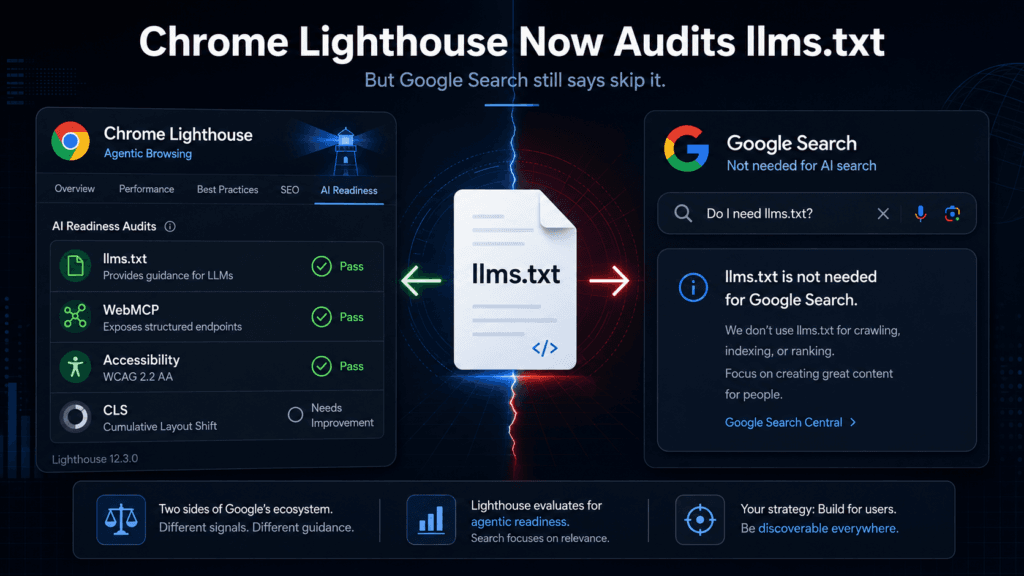
In May 2026, Google shipped Lighthouse 13.3 with a new Agentic Browsing category. One of its audits checks whether your site has an llms.txt file. That same month, Google’s Search team reiterated that llms.txt is not needed for AI Overviews and is not read by Googlebot. One part of Google is flagging the file’s absence as an audit item. Another part says it does nothing for search. Here is what is actually happening, and what it means for how you should think about AI visibility going forward.
What Lighthouse 13.3’s Agentic Browsing Category Actually Checks
Lighthouse is a performance and best-practices auditing tool built into Chrome DevTools, PageSpeed Insights, and CI pipelines. Version 13.3.0, released May 7, 2026, moved its Agentic Browsing category from experimental into the default configuration, meaning it now runs automatically on every audit.
Unlike other Lighthouse categories, Agentic Browsing does not produce a single 0 to 100 score. Google’s documentation is explicit: “the standards for the agentic web are still emerging, the current focus is to gather data and provide actionable signals rather than a definitive ranking.” What you get is a set of pass/fail signals across four audit types:
- llms.txt presence: Checks whether the file exists at your domain root. A 404 is marked Not Applicable (the file is optional). A server error (5xx) flags as a failure. If the file is present, Lighthouse also checks for a valid H1 header, minimum content length, and at least one link.
- WebMCP registration: Verifies whether your site declares tools for AI agents via the Chrome DevTools Protocol, supporting both HTML-defined and JavaScript-defined tool definitions.
- Accessibility tree quality: Validates ARIA labels, roles, and naming conventions. Autonomous agents navigate the same accessibility tree as screen readers, so poorly labeled interactive elements directly impair agent usability.
- Cumulative Layout Shift (CLS): Measures visual stability. Agents relying on element positioning to interact with a page fail when layout shifts occur after page load.
The llms.txt audit is the most discussed right now, but the accessibility and CLS signals have more immediate practical impact. Most sites have CLS and ARIA issues that are genuinely holding them back. Most sites simply do not have an llms.txt file at all.
10%
of 300,000 studied domains had implemented llms.txt as of late 2025, despite years of widespread industry coverage
0
measurable improvement in AI citation rates found when SE Ranking correlated llms.txt adoption against citation frequency across 300,000 domains
4
distinct audit signals in Lighthouse 13.3’s Agentic Browsing category: llms.txt, WebMCP, accessibility tree quality, and Cumulative Layout Shift
Google Search Has Said the Opposite, Repeatedly
Google’s Search team has been consistent. Their AI content optimization guide states directly: “You don’t need to create new machine readable files, AI text files, markup, or Markdown to appear in generative AI search.” The llms.txt specification is listed explicitly among the things you do not need to do.
Gary Illyes reinforced this at the Google Search Central Deep Dive event in Asia Pacific in July 2025. He confirmed that Google Search does not support llms.txt, has no plans to do so, and that appearing in AI Overviews requires standard SEO, not new file formats.
John Mueller’s comment on Reddit’s r/TechSEO brought it into sharper focus. When a thread asked where the industry stood on llms.txt, Mueller wrote:
“AFAIK none of the AI services have said they’re using LLMs.TXT (and you can tell when you look at your server logs that they don’t even check for it). To me, it’s comparable to the keywords meta tag, this is what a site-owner claims their site is about. Is the site really like that? Well, you can check it. At that point, why not just check the site directly?”
John Mueller, Google Search Relations, via Search Engine Journal
The keywords meta tag comparison is not casual. That tag was used by every webmaster in the late 1990s to signal page topics to search engines. It became obsolete after widespread manipulation, and Google officially recommended ignoring it in 2009. Mueller’s argument is identical: a self-reported declaration is trivially gameable. A site can claim authoritative, on-topic content in its llms.txt while the actual pages tell a completely different story.
How Google Search and Chrome Lighthouse Actually Differ
| Google Search | Chrome Lighthouse (Agentic Browsing) | |
|---|---|---|
| Reads llms.txt? | No | Yes, checks presence and quality |
| Affects rankings? | No | No (not a ranking signal) |
| Absence penalized? | No | No. 404 returns N/A, not a failure |
| Official guidance | “You don’t need to create new machine readable files” | “Without llms.txt, agents may spend more time crawling” |
| Primary scope | Web indexing for search queries | Browser-based AI agent task completion |
| Added when? | Never (not planned) | May 2026, Lighthouse 13.3 |
A 300,000-Domain Study Looked for a Citation Effect. It Found Nothing.
SE Ranking analyzed 300,000 domains in late 2025 to measure whether llms.txt correlated with higher AI citation rates. They used statistical correlation tests and an XGBoost machine learning model to surface any detectable relationship.
The headline result: no measurable connection between having the file and citation frequency. The secondary finding was more striking. When SE Ranking removed the llms.txt variable from their model, the model’s accuracy improved. The file was introducing noise rather than signal into their analysis.
Adoption data from the same study adds context. Only about 10% of the 300,000 domains had implemented llms.txt. More telling: high-traffic sites showed slightly lower adoption than mid-tier sites. If large brands with dedicated SEO teams are not prioritizing it, that says something about the value they perceive from the file.
The one segment where llms.txt delivers measurable value is developer tooling. AI coding assistants such as Cursor and GitHub Copilot retrieve documentation in real time. A well-structured llms.txt helps those tools find the right pages with fewer requests and less token overhead. That use case is real. It is also specific to sites with large, structured documentation. It is not a general citation or visibility strategy.
Why Is Lighthouse Auditing Something Its Own Search Team Dismisses?
The simplest explanation: these are different products with different objectives, built by teams that do not share the same roadmap.
Google Search is built to answer queries. Its crawler assesses whether a page can be indexed, understood, and ranked. That infrastructure has processed billions of pages for 25 years. llms.txt is redundant within it because Googlebot already crawls the actual content, checks structured data, and evaluates signals directly.
Chrome’s Lighthouse Agentic Browsing category is measuring something else entirely: whether an autonomous browser agent can navigate and interact with your site to complete a task on a user’s behalf. Think of an AI assistant comparing plans on a pricing page, filling out a contact form, or booking an appointment. That agent operates more like a screen reader than a search crawler. It needs clear structure, stable layouts, labeled controls, and a fast orientation to what the site does. That last item is precisely what llms.txt is designed to provide.
There is a longer-term signal worth noting. Lighthouse has historically audited for emerging standards before they become table stakes. Accessibility audits appeared in Lighthouse before inclusive design became a legal and technical baseline. Core Web Vitals were Lighthouse signals before they became confirmed ranking factors in 2021. PWA checks were in Lighthouse years before progressive web apps were a standard expectation. Google adding llms.txt to Lighthouse is not evidence that the file matters now. It may be the data-collection phase that precedes a more definitive decision.
The scoring design reinforces this reading. A missing llms.txt returns “Not Applicable” not a failure. Google is not requiring the file. They are measuring who implements it, how well those sites do it, and whether any patterns emerge worth acting on. That is hedging behavior, not a committed position.
Technical SEO Audit
Wondering how your site performs on the full Agentic Browsing audit?
We audit CLS, accessibility trees, Core Web Vitals, schema, and crawl structure as part of every engagement. Lighthouse passes are a byproduct of building the technical foundation correctly.
llms.txt and Agentic Browsing Readiness Checker
This tool covers both the specific criteria Lighthouse checks in its llms.txt audit and the broader Agentic Browsing signals. Use it to assess your baseline before running Lighthouse yourself.
Agentic Readiness Check
llms.txt and Agentic Browsing Audit
Check off each item that applies to your site. Scoring updates in real time.
File Basics
Content Quality (Lighthouse-Checked Criteria)
Broader Agentic Browsing Readiness
What This Actually Means for Your Site
If you can add llms.txt in under an hour, do it. No known downside. Lighthouse marks its absence as Not Applicable, not a failure. A well-formatted file takes minimal effort and leaves you positioned if agent-based traffic becomes a real channel. The implementation is also a forcing function for better internal documentation: to write a useful llms.txt, you have to think clearly about what your site's most important pages actually are.
Do not expect it to move rankings or AI citation rates. The SE Ranking study is clear. Google Search does not read the file. OpenAI and Anthropic have not confirmed using it in production citation pipelines. Any service claiming to improve your AI Overview performance through llms.txt optimization is not working from evidence.
The work that actually affects AI visibility is the same work that has always driven organic performance. AI systems cite pages that are technically accessible, well-structured, authoritative, and directly responsive to specific questions. Those are the same characteristics that drive organic search rankings. The overlap between pages that rank well and pages that appear in AI Overviews is not a coincidence. The underlying signal is quality, not a new file format.
Lighthouse adding this audit category is worth tracking. Google is mapping the agentic web, collecting data, and signaling that this is an area they expect to matter. That process unfolds over years. For now, the technical SEO fundamentals are where the leverage actually lives: clean crawlability, accurate schema, fast and stable pages, and content that answers real questions with verifiable specificity.
If your Lighthouse report currently flags CLS issues or accessibility warnings, fixing those delivers returns today, not in a hypothetical agentic future. Start there.
Sources
- Google Chrome Developers: llms.txt Lighthouse Audit
- Google Chrome Developers: Agentic Browsing Scoring
- Search Engine Land: Google Adds llms.txt Check to Chrome Lighthouse (May 20, 2026)
- Search Engine Journal: Google Says LLMs.txt Comparable to Keywords Meta Tag
- Search Engine Land: Gary Illyes Confirms Google Search Will Not Use llms.txt (July 2025)
- Search Engine Journal: LLMs.txt Shows No Clear Effect on AI Citations, 300K Domains (SE Ranking)
- Search Engine Journal: Google's llms.txt Guidance Depends on Which Product You Ask (May 2026)
Want this kind of insight applied to your stack?
Send a Message or Loom walking through your current setup and we'll come back with a scoped plan, not a sales pitch.
Get Started →