At a Glance
Google’s own Search Relations team has confirmed that “Crawled, currently not indexed” and “Discovered, currently not indexed” do not point to one specific cause. When either status shows up across a meaningful share of a site, and the usual technical explanations have been ruled out, it can point to broader quality concerns. That is a hard thing for a business owner to hear, because the fix is not a checkbox. But it does not mean the technical side of SEO stops mattering. In most cases, a technical audit is the fastest reliable way to find out whether the cause is fixable in a week or whether it points to something deeper.
| What it can mean | Google’s systems visited the page and did not add it to the index. On one page this can have many causes; across many pages it can point to broader site quality |
| What it doesn’t mean | That every excluded URL has an isolated, page-level bug, or that resubmitting the sitemap again will change the outcome |
| Why a technical process still matters | Crawl barriers, canonical errors, and thin templates are common, fixable, and have to be ruled out before a quality diagnosis means anything |
| What to do next | Run the self-check below, then work through the seven-point diagnostic framework in order, cheapest fixes first |
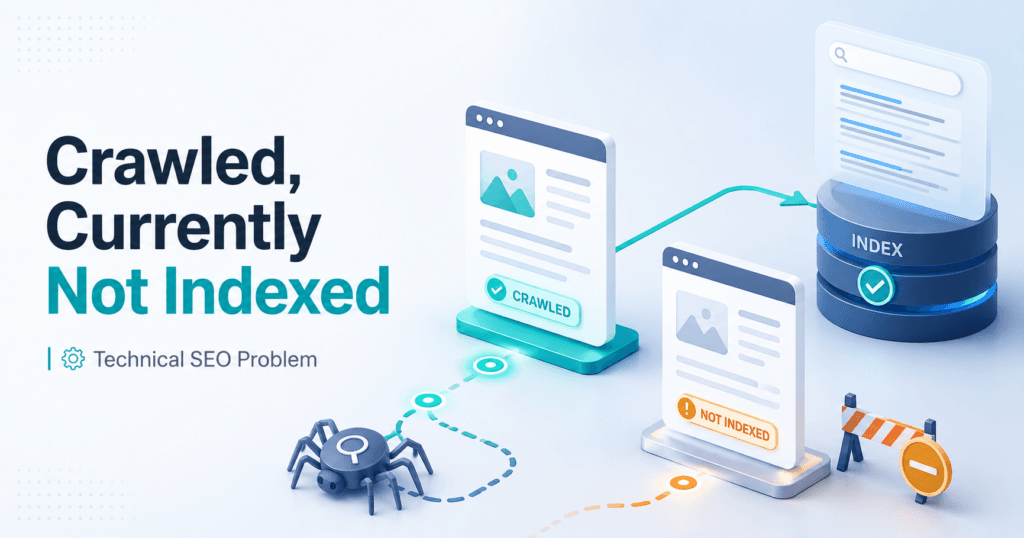
Google’s own Page Indexing Report documentation defines “Crawled, currently not indexed” as exactly what it sounds like: Google visited the page and chose not to add it to the index. Unlike a 404 or a server error, there is no error to fix. Most businesses respond to that status the way they would to any other technical issue: resubmit the sitemap, click Request Indexing again, adjust a canonical tag, wait a few weeks, repeat. Sometimes that works. Often it does not, and the status just sits there, unchanged, page after page.
Google’s own Search Relations team has now explained directly why that cycle fails so often, and it has nothing to do with sitemaps.
What Google Actually Said
The clearest explanation came straight from Google, on the Search Off the Record podcast episode “How to Read the Indexing Report”. Search Relations team members John Mueller and Martin Splitt walked through the Search Console indexing report, and Splitt asked Mueller directly whether “Crawled, currently not indexed” is often, or only sometimes, a sign of a quality issue. Mueller’s answer connected the status to something bigger than any single URL.
Mueller’s answer began with one word: “sometimes.” He explained that when Google’s systems have serious concerns about a site’s overall quality, they may crawl and index less of it. He did not say that is the usual explanation, and he did not put a number on it.
John Mueller, Google Search Relations, on Search Off the Record (transcript surfaced by Barry Schwartz at Search Engine Roundtable)
Mueller went on to explain the mechanism further: when Google’s systems have serious concerns about a site’s overall quality, they may crawl it less and index less of it on purpose, which is one of several things that can produce a “crawled not indexed” or “discovered not indexed” status. He was careful not to frame this as a technical bug to chase down on one page. His guidance was to step back and look at the site the way an outside visitor would, since it is hard to judge your own content objectively. He also pointed out that plenty of AI-assisted content is fine. When exclusion does trace back to quality, the pages involved are often the ones that read as though anyone could have written them, with nothing unique or useful for the reader.
Mueller made a similar point in a Reddit response preserved and reported by Barry Schwartz at Search Engine Roundtable, after a site owner asked whether a domain built on low-quality AI content, stuck at “Crawled, currently not indexed,” could recover by having a human rewrite everything. Mueller’s answer was that the AI-or-human question is the wrong frame: what matters is the value the site adds to the web, and a human pass over already-generic content does not make it authentic. He recommended treating a real overhaul as starting over rather than a page-by-page edit, and noted that a domain with a history of low-value content may take meaningfully longer to earn Google’s trust back than a fresh domain would.
This is not a fringe read of the data, either. A study by Indexing Insight, which tracked 1.7 million pages across 18 sitemap-submitted websites, found that quality issues accounted for the large majority of monitored indexing exclusions, far outpacing crawl errors or technical blocks. A separate dataset of 16 million pages, reported by Search Engine Journal, found that most tracked pages were not indexed during the study period, and that roughly one in five pages that did get indexed were later dropped. Both datasets come from customers of specialized indexing-monitoring tools, so they illustrate the scale of the problem within those samples rather than an internet-wide indexing rate.
88%
of monitored indexing exclusions in a study of 1.7 million pages were tied to page-quality signals, not crawl errors
62%
of tracked pages in a 16-million-page dataset were not indexed during the study period
21%
of pages that were successfully indexed were later deindexed, in the same dataset
Why the Standard Response Makes It Worse
When a page shows “Crawled, currently not indexed,” the instinct is to treat it like a broken link: find the one thing that’s wrong and fix it. So the response is usually some combination of resubmitting the URL, editing the sitemap, tweaking a canonical tag, or clicking Request Indexing on a loop every few weeks. None of that is wrong to try. It is just aimed at the wrong layer of the problem when the real cause is site-wide.
Google’s own documentation is more modest than that instinct suggests: it says there is no need to resubmit a URL for crawling, not that the outcome is fixed forever. Repeatedly requesting indexing without making a material change to the page or the site is unlikely to produce a different result, though Google can still reassess a page after a real change and another crawl. Request Indexing is a way to prompt a fresh look after fixing the suspected problem, not a fix on its own. Businesses that cycle through resubmission for months, watching the excluded-page count stay flat, are usually applying a technical tool to a pattern that resubmission alone was never built to change.
This Doesn’t Mean Skip the Technical Process
Here is the part that gets lost when “it’s a quality problem” turns into a headline: ruling that in is itself a technical SEO process, not a guess. The mundane, page-level causes of non-indexing are real, common, and often fixable in days. They have to be checked and ruled out first, both because they are the faster win and because a quality diagnosis is only trustworthy once the simpler explanations are gone. Skipping straight to “our content must be bad” without checking robots.txt is just a different kind of guessing.
Some of what follows shows up in Search Console as its own reason, separate from “Crawled, currently not indexed” itself. Robots.txt blocks, noindex tags, and canonical exclusions each get their own label in the Page Indexing report. They are still worth ruling out first, both because they are fast to check and because they can sit alongside a “crawled not indexed” pattern on the same site. A proper technical audit works through these in order, from fastest to fix to hardest to fix:
1. Actual crawl barriers
Robots.txt disallows, an accidental noindex tag, x-robots-tag headers set at the server level, broken redirect chains, or content missing or materially different in Google’s rendered HTML compared with what a browser shows. Google’s own robots.txt documentation is the reference point here, not a third-party summary of it.
2. Canonical and duplication problems
Canonical tags pointing at the wrong URL, parameter variations treated as separate pages, or near-duplicate pages competing with each other for the same query. Google explains how it actually resolves these in its own canonicalization documentation.
3. Weak internal linking
Orphan pages with no path from the homepage, or important pages buried deep enough in the click structure that both users and crawlers rarely reach them without dedicated internal link architecture (a heuristic worth checking, not a strict cutoff).
4. Thin service or location pages
Pages built to fill out a menu or target a city name, with little content beyond a swapped headline and the same three paragraphs used everywhere else.
5. Templated, generic content
Pages that read as though any competitor’s name could be substituted in without anyone noticing, including AI-drafted content published with little or no editing for specificity.
6. Pages that add nothing new
Content that restates what every competitor already publishes, with no original data, example, or point of view that would give Google a reason to prefer it.
7. Broader site-quality and trust signals
Thin about-us and author information, no evidence of real expertise, or a general pattern across the site of content that reads as built for search engines rather than people.
The first three are conventional technical SEO work. They are also the ones a business can usually fix without touching a single word of content. The last four are where a technical audit stops being about code and starts being an honest read of whether the content itself earns a place in the index. Both halves matter, and skipping either one leads to the wrong conclusion.
Is It Technical or Is It Quality? Run the Self-Check
The checklist below sorts common causes into the two categories above. Check every statement that is true for your site right now.
Crawled, Not Indexed: Self-Check
Where does your site actually stand?
Check every statement that is true for your site right now, then see where to start.
Technical red flags
Site-quality red flags
What Fixing an Actual Quality Problem Looks Like
If the technical items above check out clean and the quality flags are the ones piling up, the fix is slower than a code change, but it is not mysterious, and Google has documented what it is looking for. Its people-first content guidance asks whether a page demonstrates firsthand expertise, and whether a reader leaves having actually learned enough to act on it. Its separate guidance on AI-generated content is explicit that the concern is not automation itself but content produced primarily to manipulate rankings rather than help a reader. A light copyedit of already-generic content rarely moves the needle against either standard, since the underlying page still has nothing new to offer. The pages worth saving are usually the ones covering something the business genuinely knows, expanded with real specifics. The rest are often better consolidated into fewer, stronger pages than kept alive individually.
This is also where GEO and AI-visibility work overlaps with traditional indexing. A page that is too generic to earn a place in Google's index is, for the same reasons, too generic to get cited by an AI answer engine. Fixing the underlying quality problem tends to help both at once.
Scope the problem before you scope the fix
One URL affected: inspect the page itself. One template affected: inspect the template and its internal links. A large share of the site affected: investigate site-wide technical patterns first, then overall content quality.
A Short Checklist for This Week
- Pull a current export of every URL marked "Crawled, currently not indexed" and "Discovered, currently not indexed" in Search Console, and sort by how long each has been excluded.
- Spot-check ten of those URLs directly: confirm the status code, the canonical tag, and whether the page renders the same to a crawler as it does to a browser.
- Check whether the excluded pages share a template. If most of them do, the pattern is more useful than any single page.
- Read three of the excluded pages as if you were a stranger. Ask what a reader gets there that they could not get from the top three ranking results for the same query.
- Do not resubmit the sitemap or spam Request Indexing as a substitute for the steps above. It will not change a decision Google has already made.
None of this means technical SEO stops mattering once quality enters the conversation. It means technical SEO is the process that proves whether quality is actually the issue, instead of guessing at it. If a full technical and indexation audit would help you find out which one you're dealing with, send a message or a Loom and we will take a look. Businesses working from DFW or anywhere else are welcome to reach out the same way.
Frequently Asked Questions
Per Google's own Page Indexing Report documentation, it means Google's crawler visited the page and made a decision not to add it to the index. Unlike a "Discovered" status, this is not a queue or backlog issue. Google has already looked and already decided, which is why resubmitting the same URL rarely changes anything on its own.
No. Google's own documentation defines "Discovered, currently not indexed" as Google knowing the URL exists but not having gotten around to crawling it yet, often a genuine crawl-budget or priority issue. "Crawled, currently not indexed" means Google visited the page but has not added it to the index. The documentation does not identify one specific cause for that decision. On the Search Off the Record podcast, Google's John Mueller said both statuses can sometimes increase together when its systems have serious concerns about a site's quality, though he was clear that is one possible explanation among several, not the default one.
Usually not by itself. Google's guidance is that there is no need to resubmit a URL for crawling, and repeatedly requesting indexing without changing anything is unlikely to produce a different result. Request Indexing is most useful after you have made a real fix, as a way to prompt a fresh look, not as a substitute for the fix itself.
Google's own guidance on AI-generated content is that the method of writing is not the disqualifying factor by itself. The problem is content that reads as generic and interchangeable, whether it was written by AI, a low-cost freelancer, or copied in structure from a competitor. AI-drafted content edited for real specificity is treated differently than AI content published with no meaningful editing.
Yes. A technical audit is how you rule out the cheaper, faster explanations first, and it is also how you find out which pages are worth rewriting versus consolidating. Skipping straight to "our content must be bad" without checking crawl barriers, canonicals, and internal linking is its own kind of guessing.
There is no fixed timeline. John Mueller has said, in the Reddit response referenced above and reported by Search Engine Roundtable, that sites with a long history of low-value content may take meaningfully longer to regain trust than a site making a first-time fix. Treating the rewrite as a real overhaul, rather than a light edit, tends to produce a clearer before-and-after signal for Google to reassess.
Want this kind of insight applied to your stack?
Send a Message or Loom walking through your current setup and we'll come back with a scoped plan, not a sales pitch.
Get Started →